
‘graduate-research-news’
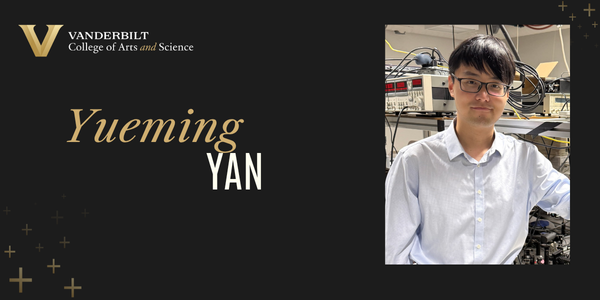
Metal and semiconductor particles could transform health and safety technologies
Jul. 24, 2025—A new breakthrough in the field of physics led by doctoral student Yueming Yan could allow for the creation of small, thin, low-power optical devices to be used in both medical imaging and environmental sensing. In a study published in ScienceAdvances, Yan and his colleagues, including Associate Professor of Chemistry Janet Macdonald and Stevenson Professor...
Good chemistry: how chemistry students expand their skill set through hands-on, experiential learning
Jul. 9, 2025—Whether you talk to a graduate or undergraduate student in the Department of Chemistry about why they study the field, their responses all evoke the same sentiment: a curiosity for the world and a desire to discover the unknown. All students can fulfill this desire by attending classes and learning from knowledgeable faculty members. However,...

A Conservative Defense: Downstream NFLs resist evolutionary blitzes
Jun. 11, 2025—Danial Asgari, a postdoctoral researcher in the Tate Lab, and Ann Tate, associate professor of Biological Sciences, recently published a study in Molecular Biology and Evolution titled “How the Structure of Signaling Regulation Evolves: Insights from a...

Scientists discover new evidence of intermediate-mass black holes
May. 23, 2025—In the world of black holes, there are generally three size categories: stellar-mass black holes (about five to 50 times the mass of the sun), supermassive black holes (millions to billions of times the mass of the sun), and intermediate-mass black holes with masses somewhere in between. While we know that intermediate-mass black holes should...
Vanderbilt researchers find warming quickens aging-related mortality in mosquitoes
Sep. 25, 2024—New research shows that warming and aging act as a one-two punch, lowering mosquito lifespans and fanning the flames of bacterial infections. These findings highlight how climate change could alter the risks of disease spread by mosquitoes.
Researchers discover the evolution of seasonal anticipation in cyanobacteria
Sep. 11, 2024—New research led by recent Vanderbilt Ph.D. alumna Maria Luísa Jabbur from the Johnson Lab and BBSRC Discovery Fellow at the John Innes Centre, in the UK has uncovered that even cyanobacteria—tiny organisms with a generation time of just five to six ho...
Bridging the gap: Combining music and astrophysics to improve representation in science
Feb. 27, 2024— As a child, Shaniya Jarrett was fascinated by space and science fiction, but didn’t believe that pursuing the big scientific questions of the universe was a viable career option. Now a second-year astrophysics graduate student in the Fisk-Vanderbilt Master’s-to-Ph.D. Bridge Program, Shaniya is creating opportunities for young women of color that she would have...
VU graduate student examines Aspergillus genus virulence as part of multi-university study
Dec. 6, 2022—Annie Hatmaker, along with a team of researchers including her adviser, Cornelius Vanderbilt Professor of Biological Sciences Antonis Rokas, recently published a study identifying the differences in virulence among Aspergillus species, a common human-p...