
Never forgotten: Tiffany Fracchia’s class helps identify missing American WWII soldier in France
There are more than 80,000 unaccounted-for American service personnel from past conflicts, according to the U.S. Department of Defense POW/MIA Accounting Agency (DPAA). More than 70,000 are missing from World War II alone, leaving their surviving families and descendants with questions, but no answers.
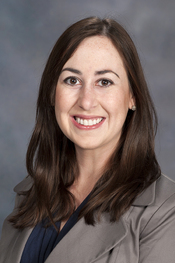 Growing up, Associate Professor of the Practice of Anthropology Tiffany Fracchia was taught to respect and honor military personnel; her grandfather served in World War II and her father served in the Vietnam War. That life-long value was so deep-rooted that it influenced her academic research: Fracchia partnered with the DPAA to recover and repatriate missing crew members from a WWII plane crash in France, simultaneously teaching her students valuable forensic archaeology field methods.
“My forensic anthropology casework here in Middle Tennessee assists with locating, recovering, and identifying human remains. I also conduct this work internationally, assisting survivors of conflict with ways to recover and identify their missing loved ones in places like Columbia and Tanzania,” Fracchia said. “When I learned that the DPAA was partnering with universities that have students trained in forensic recovery methods, I realized this was an opportunity to provide students with ways to use the skillsets they develop in class by applying them to global needs.”
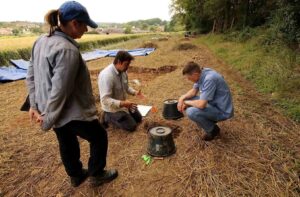
The fieldwork that Fracchia and her students conducted in France made a huge impact: they recently helped to successfully identify U.S. Army Air Force 1st Lt. Gerard J. Melofchik, 24, of New York, New York. Lt. Melofchik was killed in action on August 1, 1944, when the B-17G aircraft he was piloting was struck by anti-aircraft fire, collided with another aircraft, and crashed in an agricultural field near Néron, France. Of the nine crewmembers aboard the B-17G Stormy Weather, two were captured, four were identified from remains found near the crash site, and three, including Melofchik, were unaccounted for.
For more than 80 years, Melofchik’s family and descendants never received confirmed information about his fate—until this past September.
“We were incredibly proud when we were notified that our recoveries were confirmed and an identification was made from our efforts,” Fracchia said. “Until DPAA scientists evaluate the materials collected, everything is ‘possible’ evidence.’ Analysis of evidence collected was not scientifically performed in the field. We assessed the value of the materials found and retained evidence in an official chain of custody format similar to domestic investigations in the U.S. We were excited and hopeful each time we recovered this type of material in the field.”
With this information, Melofchik’s descendants held a memorial for him in November in Newtown, Pennsylvania. Fracchia was invited to attend and said the experience was both meaningful and humanizing. Representatives from The Hershey Candy Company also attended, because in one of his letters home, Melofchik asked his parents to send him and his crew Hershey chocolate bars.
“Knowing someone’s favorite candy bar is a reminder that this person was a young man with likes and dreams and goals,” she said. “He was 24 years old and halfway around the world serving his country. It magnifies the loss and highlights the sacrifice of war. It also amplifies the responsibility of honoring our nation’s promise to leave no one behind. The family has also kept the memory of Gerard alive all of these years. They have kept the Western Union telegram notifying his family of his missing status. We also saw a letter dated July 31, 1944, that Gerard wrote to his parents—just one day before the crash that took his life.”
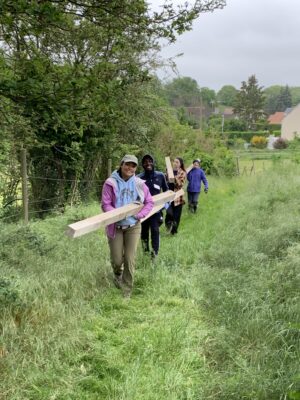
On their trips to France in 2022 and 2023, Fracchia and her students—alongside various international volunteers in Europe—focused their efforts in and around the field where the plane had crashed. In preparation for this work, students were required to perform introductory field methods training at a local archaeology site at Two Rivers Mansion.
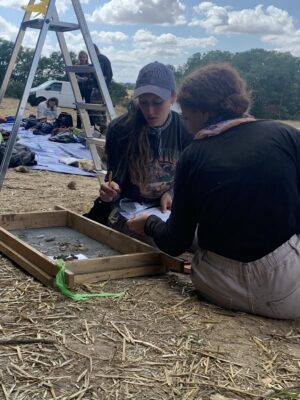
Once in France, the team received supplies in crates shipped by the DPAA, which they used to construct the tools they would need to excavate and identify various items from the crash. Students then performed pedestrian surveys, an archaeological and forensic field method that is used to investigate sites for evidence on the surface of the ground.
Waking at 5 a.m. to head to the site, the team worked Monday through Friday, performing physical field work of excavating, aswell as sifting through and processing materials deemed valuable to be sent back to DPAA for further analysis. On the weekends, they would travel to nearby cities to learn more about the country and its culture.
At one point, Fracchia said members of the team started developing rashes, and they learned that the area contained oak processionary caterpillars, which have hair that is toxic to mammals. The team began taking allergy medicine, but the caterpillar hairs were in the air and soil, requiring them to wear masks and protective Tyvek suits.
“I am very proud of the work ethic of the students and volunteers who were part of this project,” Fracchia said. “Like me, many of the students have active service members and veterans in their families, and they were excited to contribute to such meaningful work. Our team worked Monday through Friday for six weeks each field season. Outdoor field conditions were not always ideal, but team members did not complain and worked very hard to complete as much excavation activity as possible.”
Alyssa Bolster, BA’22, said she jumped at the chance to join the team. Now an anthropology Ph.D. candidate at Brown University, Bolster said the experience was extremely relevant and formative to her studies and overall career goals, while also affecting a topic close to her heart.
“Excavating in rural France was truly an unforgettable experience,” Bolster said. “I come from a military family. My father served as a crew chief for the 160th Special Operations unit out of Fort Campbell, Kentucky, most of my life, and now is a civilian working with the army. My brother also recently enlisted and is now training with the 160th. I have always held the utmost respect for my military family members—my dad is definitely my hero—and for the sacrifices they make to do their job. Hearing that we were able to bring some peace and answers to another military family after so many years was really rewarding for me, and also a really amazing story to share with my dad and brother.”
The team was visited in the field by local government officials, local history enthusiasts, and eyewitnesses of the crash in Néron. Working with volunteers and residents gave students a better understanding of the lasting impact the crash continues to have on the town, as well as providing them with a unique opportunity for both professional and cultural exchange.
One man who visited the team recounted seeing the plane crash in the field as a small child. They also met a woman who had been outside as a baby during the crash and was able to accurately describe what happened based on what her mother told her. Fracchia said they realized how important the crash was to the town’s local heritage with the number of visitors to the site each summer during excavations. Citizens of the town were always excited to share the stories they knew about the war, the crash, and the remnants of the aircraft. In fact, for many years, one of the aircraft’s wings served as the side of a storage shed. It had been collected at the time of the crash and repurposed. The town now keeps the wing in storage, hoping to retain this reminder of local history.
The team recognized the importance of preserving this heritage beyond their excavation efforts. To help the town preserve this piece of their story, Fracchia and her team were able to make sure part of the wreckage was returned to the town. The selected pieces they felt were relevant and constructed a display to be kept in the town hall.
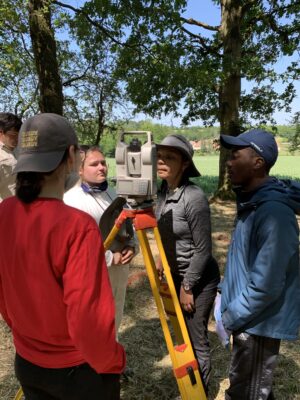
Fracchia expressed that projects such as this one not only help to encourage further student engagement in the field beyond the classroom, but they hold even greater significance in the humanitarian efforts to provide some answers for the loved ones of missing soldiers.
“I can easily teach methods in the classroom, but when students are able to apply the methods to real-world problems and achieve meaningful goals, they pursue careers with a greater dedication to positive community impacts,” she said. “This collaborative project with the DPAA brought together students, volunteers, and community members from multiple countries and institutions. It focused on the use of scientific, investigative methods for the benefit of providing living people with information they have been waiting over 80 years to receive.”